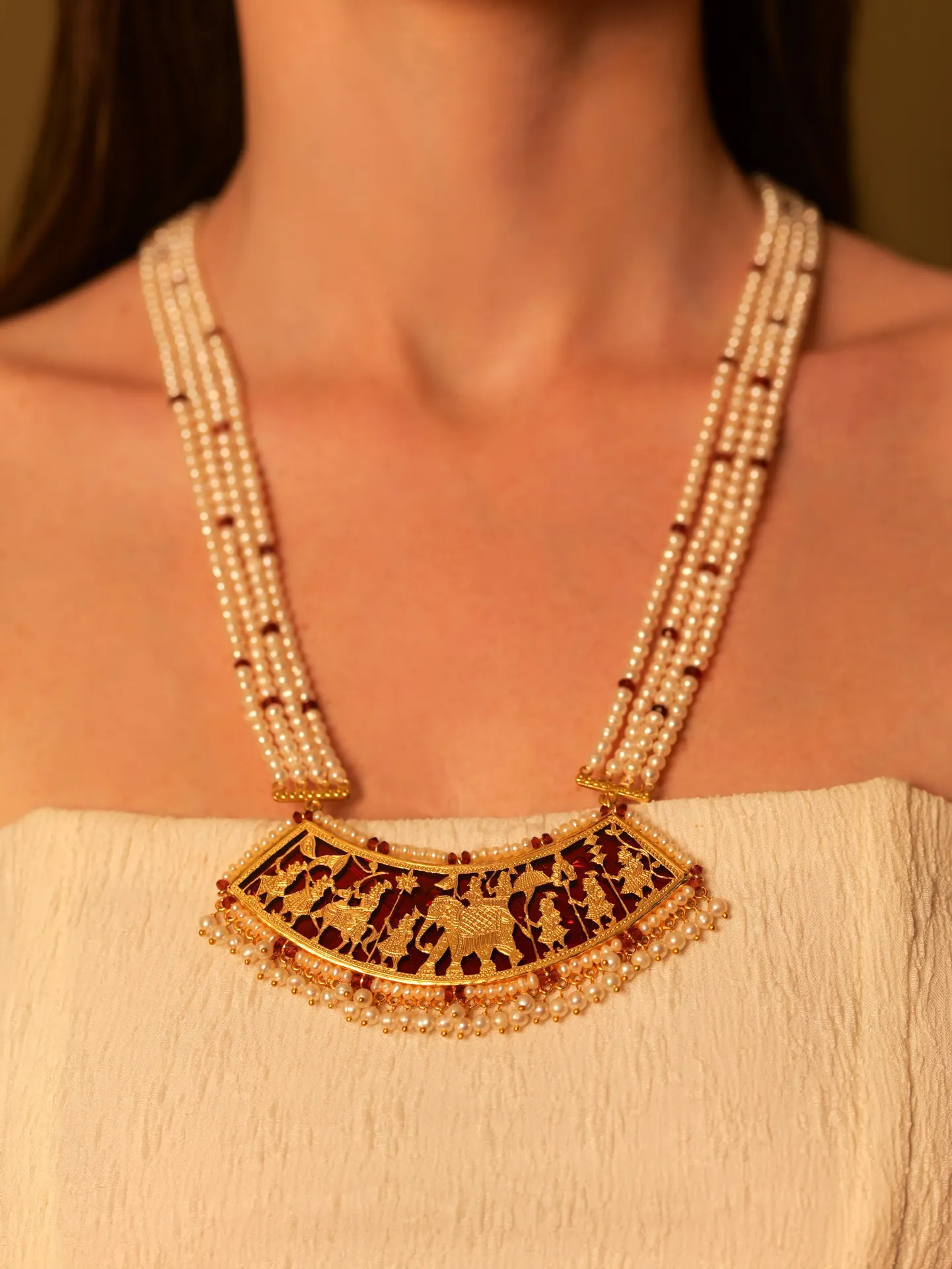
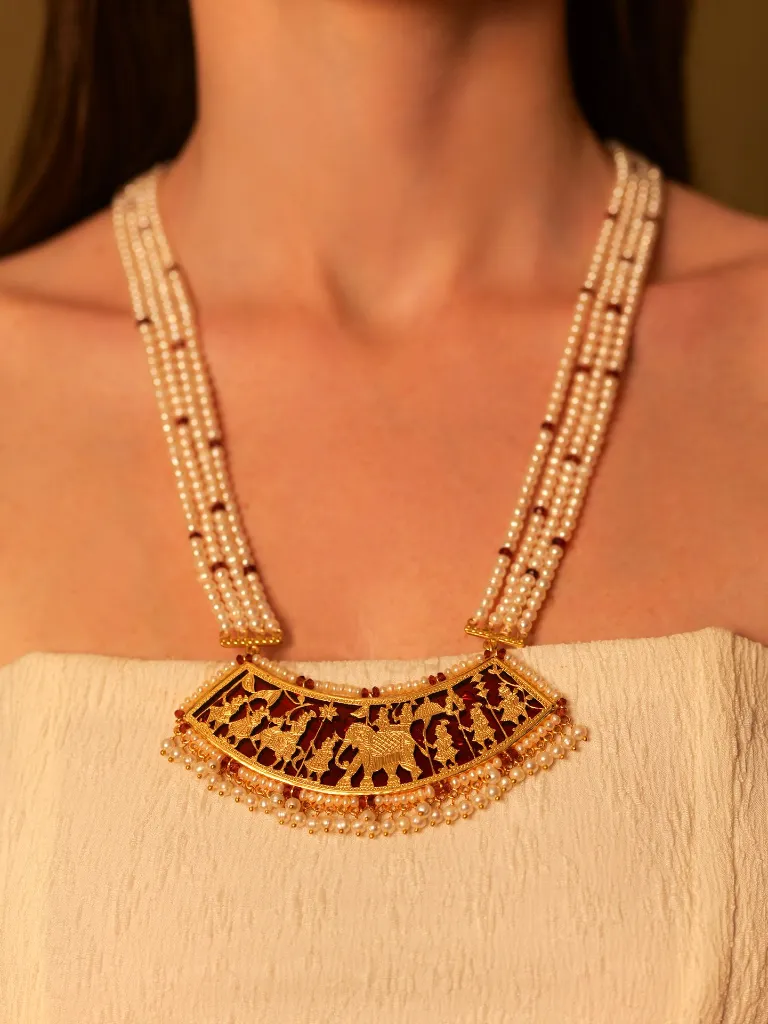
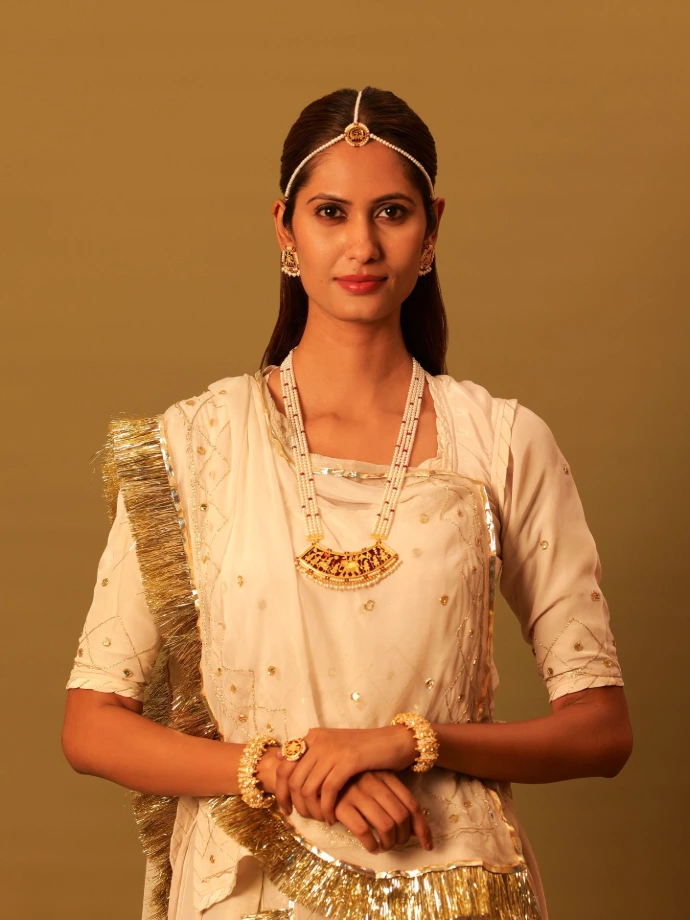
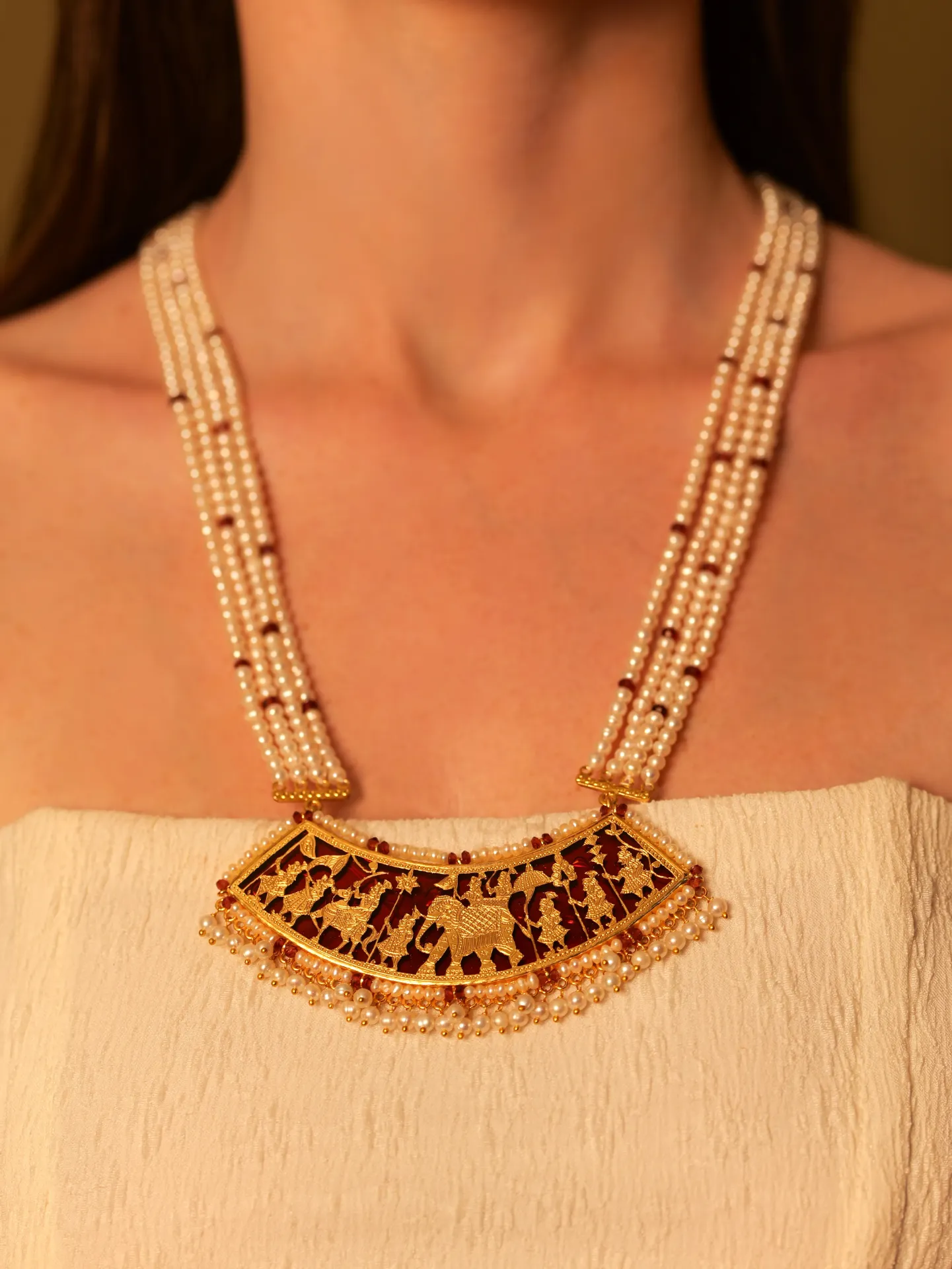
The Laal Baraat Necklace is the narrative centrepiece of the collection. Its broad, gently curved panel creates an unusually expansive canvas for Thewa work. Against a rich translucent red ground, finely worked golden figures form a continuous ceremonial procession.
The eye is immediately drawn to the central elephant, surrounded by mounted and standing figures. Horses, riders and attendants extend towards either side, producing the rhythm of a procession rather than a conventional symmetrical jewellery motif. Small floral and decorative elements occupy the negative spaces between figures.
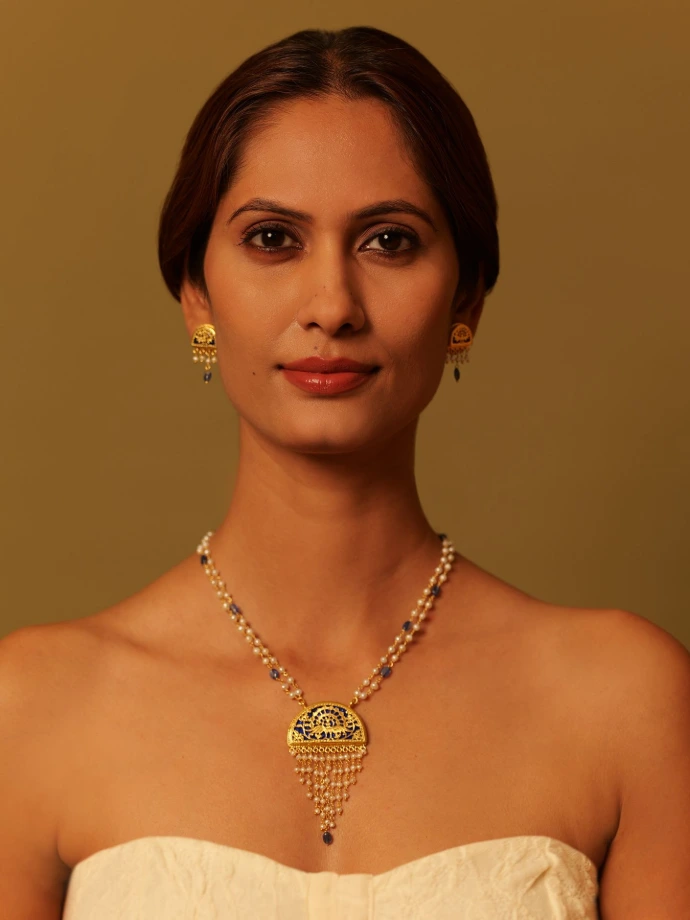
Multiple strands of petite pearls form the necklace, punctuated by deep red beads. Their restraint is important: rather than competing with the central artwork, they create a soft, almost textile-like frame around it. A delicate fringe of pearls and red accents along the lower edge introduces movement when worn.
The earrings reinterpret the procession as individual miniature scenes. A mounted figure appears against the same red ground, surrounded by a pearl-and-red border and finished with suspended pearls. Their slightly architectural silhouette gives them the character of tiny framed paintings.
The ring takes another element from the procession—a prominently rendered elephant—and places it within a circular composition. The golden animal stands dramatically against the red ground, enclosed by pearls and intermittent red accents. Viewed closely, it becomes almost a miniature medallion.
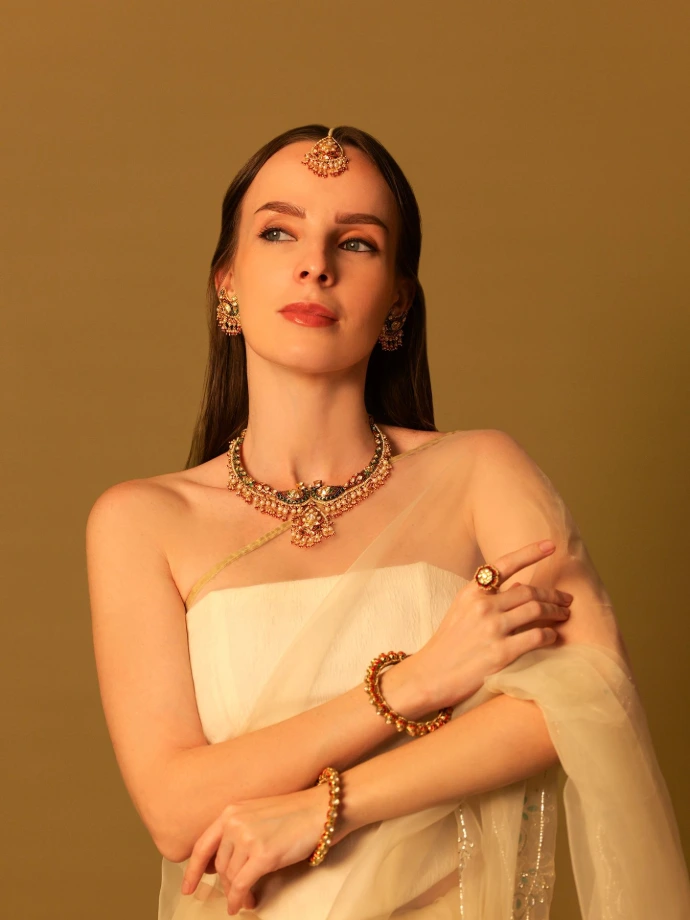
The maang tikka provides the most abstract interpretation. Its circular Thewa composition is surrounded by pearls and connected to fine pearl strands, allowing the piece to sit delicately across the hair while retaining the collection's unmistakable red-and-gold identity.
Across all four pieces, Laal Baraat transforms one of Rajasthan's most recognisable ceremonial experiences into a series of miniature wearable narratives.
A procession once meant to pass by.
This one was made to be passed on.


![vimeo - [Video]](/web/image/product.image/172/image_128/vimeo%20-%20%5BVideo%5D?unique=ef77591)